According to Catholics, Nepomucen is to protect against rough waters and flooding, and on the other hand - against drought. That is why his figures, called nepomukami, were for many centuries placed over waters, near bridges, fields or at road intersections, but also on public and church squares. The baroque figure of the saint stands, among others on the cathedral square, at the presbytery.
Nepomuki is easy to recognize by several attributes: the stars already mentioned around the head of the saint, finger on the lips, a closed book or padlock symbolizing silence or held in the hands of a crucifix or martyr's palm. Saint is the patron of priests, rafters, bridge builders, millers, as well as people wrongly judged and slandered.
The canon was beatified only in 1721 by Pope Innocent XIII, and canonized on March 19, 1729 by Benedict XIII. His Catholic liturgical memorial is celebrated on May 21. In the Opole Cathedral, he is the patron of the confession chapel, recently renovated as part of the Polish-Czech project, by the cathedral parishes of the dioceses of Opole and Ostrava-Opava.
Until recently, there was a historic baptismal font with the oldest coat of arms of Opole. During conservation work, however, it was moved to the left nave of the church, and an interesting discovery was made in the chapel. Under the floor, in the basement, a brick octagon, i.e. an octagonal building, was built up with bricks. Look carefully under the feet, because to commemorate this discovery the outline of an octogon was marked on it. It could have been an open baptismal font, a well, or a tomb - we can certainly never find out ...
Chapel of St. John of Nepomuk
Born in 1350 in the Czech Nepomuk near Pilsen, the priest, was a canon in the cathedral of St. Wit, Wacław and Wojciech at Prague's Prague Castle and confessor to Queen Zofia Bavarian.


How it working
To listen to the history of monuments as part of the "Discover History" project, you need to follow a few simple steps. Below, we present a short, step-by-step "user manual" to provide a relatively simple way to access the mini-auditions.
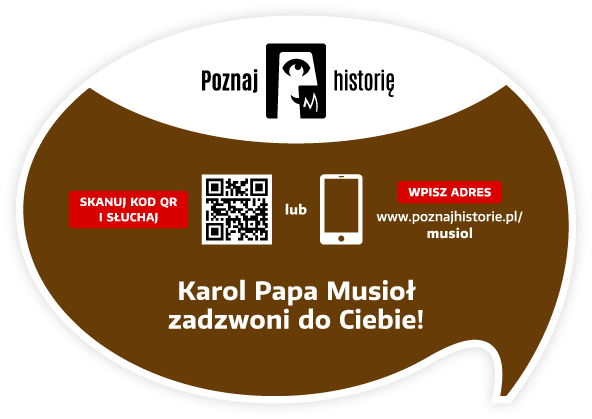
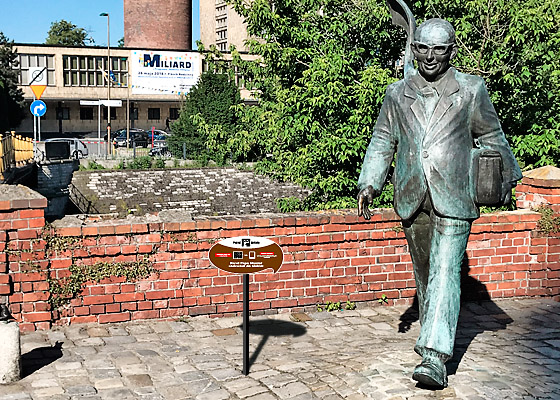
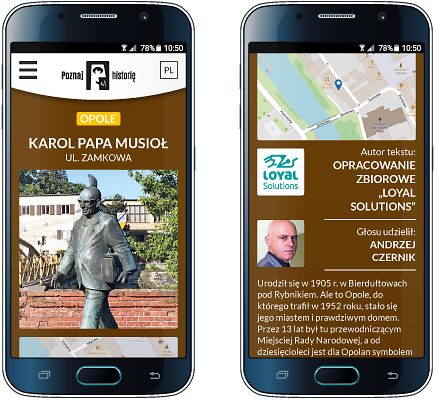
You need a smartphone with a camera. The camera lens should be pointed at the information plaque located next to the monument. Below is a view of the plaque itself and its example location next to the Karol Musioł monument in Opole.
After pointing your smartphone's camera at the QR code located on the right side of the plaque, the app's welcome screen will appear, followed by a screen with the name, photo of the monument, and the "START" button.
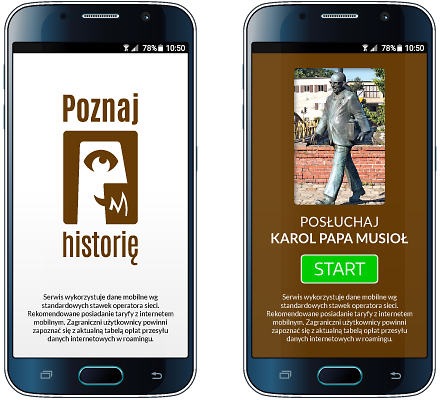
The "START" button starts the audio recording process.
Your smartphone will prompt you with the next steps after you listen to the story or pause it. Please keep an eye on your smartphone screen!
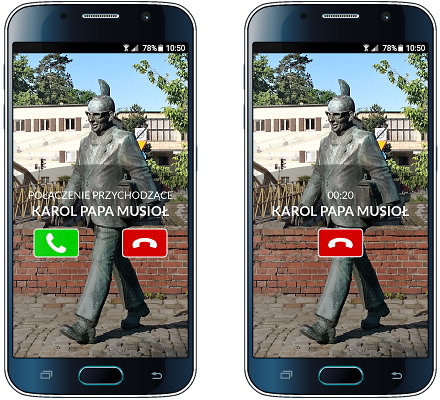
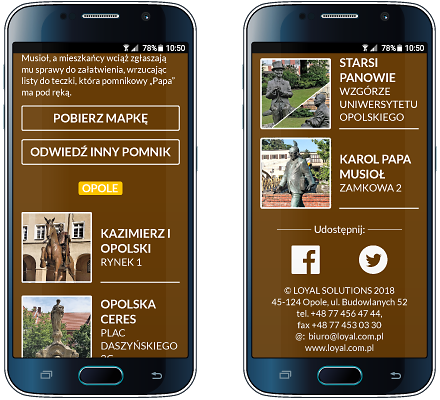
Other available options: brief information about the monument, author of the text and recording, list of other monuments in the city included in the "Discover History" project, downloadable map of monuments, video, and social media links
Would you like to implement the project in your city as well?
ContactSelect an object
View gallery
Monuments in cities remind us of the history of places and people, and allude to important events. They are also works of art. Bronze, metal, wood, or concrete transformed into the form of a monumental obelisk attract attention. We enjoy sitting by them, taking photos, and making appointments.
Project partners
Implementing the "Discover history" project in each city requires the involvement of many people: programmers, graphic designers, writers, actors, sound engineers, and coordinators. It is thanks to them that this project came to life.
Our ambition is to continually expand its reach. Therefore, we thank our current partners and invite additional cities, institutions, companies, and individuals to collaborate!

Would you like to become our Partner of the project or monument?
ContactContact
Are you interested in implementing the project in your city? Want to learn more? Want to learn more? Write to us, call us! We'll contact you and arrange a meeting. We'll prepare materials and a proposal for you.

QR Communication Sp. z o.o.
tel. +48 735 147 911
tel. +48 606 881 118
paulina.panusch@poznajhistorie.pl
kontakt@poznajhistorie.pl
Visit Social media:
Share Social media: